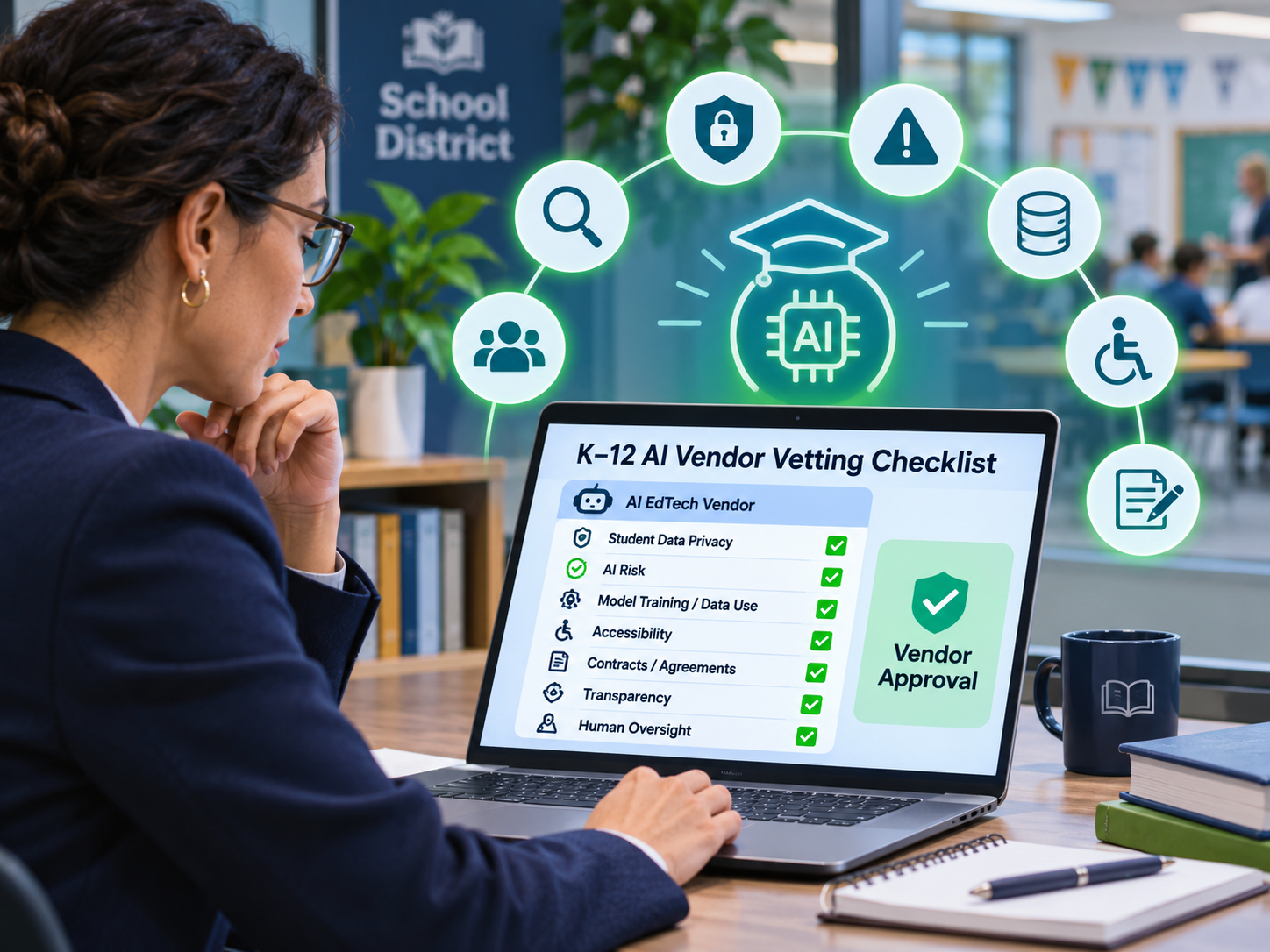
K-12 AI Vendor Vetting Checklist
Artificial intelligence is quickly becoming part of everyday school operations. Teachers are using AI to draft lesson plans, students are using AI-powered learning tools, administrators are exploring AI for productivity, and vendors are adding AI features to existing platforms.
For school districts, the question is no longer whether AI will show up in classrooms. It already has.
The more important question is whether districts have a repeatable process to review AI vendors before student, parent, teacher, or staff data is collected, processed, analyzed, or used to train an AI system.
Traditional vendor privacy reviews are still necessary, but AI creates new risks that many standard privacy questionnaires do not fully address. Districts need to understand not only what data a vendor collects, but also how that data is used, whether it is used to improve or train AI models, whether outputs are explainable, and whether the tool creates new risks related to bias, accuracy, accessibility, transparency, and student safety.
Below is a practical checklist K-12 districts can use when evaluating AI vendors. The questions are an evaluation aid, not a certification or a substitute for applicable legal requirements. The review should consider the product, the district’s intended use, the ages of users, and the data actually accessible to the vendor.
For broader governance, the NIST AI Risk Management Framework provides a voluntary approach to governing, mapping, measuring, and managing AI risks.
1. Identify Whether the Product Actually Uses AI
The first step is to determine whether the vendor’s product uses artificial intelligence, machine learning, automated decision-making, generative AI, predictive analytics, or similar technology.
Districts should not rely only on marketing language. Some vendors clearly advertise AI features, while others may describe the same functionality as “personalization,” “recommendations,” “automation,” “adaptive learning,” “intelligent tutoring,” “risk scoring,” or “automated feedback.”
Ask the vendor:
- Does the product use AI, machine learning, large language models, automated decision-making, or predictive analytics?
- Which specific features use AI?
- Is AI used only for administrative support, or is it used directly with students?
- Is the AI feature optional, or is it built into the core product?
- Can the district disable AI features if needed?
- Which features and integrations are enabled in the district’s deployment, and which are merely available or optional?
- Can connected third-party applications or AI providers access student data, and under what configuration or permissions?
This step matters because a district cannot manage AI risk if it does not know where AI is being used. Distinguish confirmed data flows in the district’s configuration from potential exposure through optional features or integrations; ask the vendor to verify the difference rather than assuming all available integrations are active.
2. Determine What Data Is Collected
AI tools often depend on large amounts of data. Before approving an AI vendor, districts should identify exactly what information the product collects from students, parents, teachers, staff, and devices.
This includes obvious data, such as names, email addresses, grades, assignments, chats, prompts, uploaded files, and assessment results. It also includes less obvious information, such as IP addresses, device identifiers, usage logs, behavioral data, keystrokes, audio, video, screen recordings, and metadata.
Ask the vendor:
- What student data is collected?
- What staff or teacher data is collected?
- Are prompts, chats, uploaded files, or generated responses stored?
- Are audio, video, images, or biometric-like data collected?
- Are persistent identifiers, cookies, pixels, analytics tools, or tracking technologies used?
- Is data collected from students under 13?
For K-12 schools, “data collection” should be interpreted broadly. AI tools may create new records, inferences, summaries, classifications, recommendations, or risk scores that become part of the student data environment.
3. Confirm How Data Is Used
The most important AI privacy question is not simply “What data do you collect?” It is “What do you do with the data after you collect it?”
A vendor may collect data to provide the service, but the same data could also be used to improve the product, train models, develop new features, personalize advertising, build profiles, or support unrelated commercial purposes.
Ask the vendor:
- Is district, student, or staff data used only to provide the contracted service?
- Is data used to train, fine-tune, or improve AI models?
- Is data used to develop unrelated products or services?
- Is data used for advertising, targeted advertising, profiling, or marketing?
- Is de-identified, aggregated, or anonymized data used for AI model development?
- Can the district opt out of model training or product improvement uses?
Districts should be cautious when a vendor says data is “de-identified” or “aggregated” without explaining the process. AI systems can create re-identification and inference risks, especially when datasets are combined or used to generate predictions about students.
4. Review Contract Language for AI-Specific Protections
A signed agreement is not enough unless the agreement actually addresses AI-related risks.
Districts should make sure vendor contracts, DPAs, terms of service, privacy policies, and AI addenda clearly define acceptable data use. The agreement should prohibit the vendor from using student data for model training, advertising, profiling, or unrelated commercial purposes unless the district has specifically reviewed and approved that use.
Look for contract language covering:
- Data ownership
- Restrictions on use of student data
- Prohibition on advertising and targeted advertising
- Prohibition on unauthorized AI model training
- Data retention and deletion
- Subprocessors and third-party AI providers
- Security controls
- Breach notification
- Parent, student, and district access rights
- Human oversight
- Audit rights or documentation obligations
- Compliance with FERPA, COPPA, state student privacy laws, and district policy
A COPPA school-consent determination does not replace a signed Data Privacy Agreement when state law requires one. The FTC explains that school authorization under COPPA is limited to appropriate educational uses, while state privacy laws can impose additional contractual obligations. FERPA and district policies can also require separate safeguards. Districts should verify which obligations apply before approval.
Districts should also check whether vendor terms allow unilateral changes. AI products change quickly, and a vendor’s acceptable use terms, AI terms, privacy policy, or subprocessors may change after the district approves the product.
5. Identify Third-Party AI Providers and Subprocessors
Many education vendors do not build their own AI models. Instead, they integrate with third-party AI providers, cloud platforms, analytics tools, transcription services, chatbot providers, or large language model APIs.
This creates a second layer of review.
Ask the vendor:
- Which third-party AI providers are used?
- What data is shared with those providers?
- Are prompts, responses, files, or student records transmitted to third-party AI systems?
- Are third-party providers allowed to retain or train on the data?
- Where is the data stored and processed?
- Are subprocessors listed publicly and updated when they change?
- Will the district be notified before new AI subprocessors are added?
If a vendor sends student data to another AI provider, the district needs to understand the privacy, security, retention, and model-training terms of that downstream provider as well.
6. Evaluate Security Controls
AI vendors should meet the same security expectations as other vendors that handle student data, but AI may introduce additional risks because prompts, uploaded files, chat histories, and outputs can contain sensitive information.
Ask the vendor:
- Is data encrypted in transit and at rest?
- Is role-based access control supported?
- Is multi-factor authentication available for administrators?
- Are logs maintained for access and activity?
- Is customer data logically separated from other customers?
- Has the vendor completed a recent SOC 2, ISO 27001, penetration test, or similar security assessment?
- How are AI prompts and responses secured?
- How does the vendor prevent unauthorized access to student data through AI outputs?
Districts should also ask whether the vendor has tested for prompt injection, data leakage, unauthorized disclosure, and other AI-specific vulnerabilities.
7. Assess Accuracy, Bias, and Human Oversight
AI systems can generate incorrect, misleading, biased, or inappropriate results. This is especially important when AI is used for tutoring, grading, discipline, counseling, intervention, special education, risk scoring, or recommendations about students.
Ask the vendor:
- What decisions or recommendations does the AI system make?
- Can AI outputs affect grades, placement, interventions, discipline, services, or student opportunities?
- Is a human required to review AI-generated outputs before they are used?
- How does the vendor test for bias or disparate impact?
- What are the known limitations of the AI system?
- Does the vendor provide documentation explaining how the system works?
- Can the district challenge, correct, or override AI-generated results?
For high-impact student decisions, AI should support educators, not replace professional judgment.
8. Review Transparency for Parents, Students, and Staff
Districts should be able to explain how AI tools are being used. That requires clear vendor documentation and district-facing transparency.
Ask the vendor:
- Does the vendor provide plain-language documentation about AI features?
- Can the district disclose AI use to parents and staff?
- Are users notified when they are interacting with AI?
- Are students told when feedback, recommendations, or responses are AI-generated?
- Can the district obtain documentation for board review, parent questions, or public records requests?
Transparency builds trust. If a vendor cannot clearly explain how its AI works, what data it uses, and what safeguards are in place, the district should slow down the approval process.
9. Confirm Accessibility and Inclusive Design
AI tools must also be reviewed for accessibility. If an AI product is used by students, parents, teachers, or staff, districts should evaluate whether the tool is accessible to users with disabilities.
Ask the vendor:
- Does the product claim conformance to WCAG 2.1 Level AA, and which specific criteria have exceptions or limitations?
- Has the vendor completed an accessibility audit?
- Is a current VPAT or Accessibility Conformance Report available?
- Are AI-generated images, videos, documents, or responses accessible?
- Does the tool work with screen readers, keyboard navigation, captions, and assistive technology?
- Can accessibility barriers be reported and remediated?
AI should not create new barriers for students, families, or staff members who rely on accessible technology. Under the ADA Title II web and mobile accessibility rule, covered public entities generally must address web content and mobile apps they make available, including through vendor arrangements, subject to the rule’s scope and exceptions. An available VPAT or Accessibility Conformance Report is evidence to review, not proof of complete compliance.
10. Establish Ongoing Monitoring
AI vendor vetting should not be a one-time event. AI products change frequently. Vendors may add new features, new model providers, new data uses, or new subprocessors after the initial review.
Districts should create a process to monitor:
- Changes to privacy policies
- Changes to AI terms
- New AI features
- New subprocessors
- Security incidents
- Accessibility updates
- Contract expiration dates
- Parent or staff complaints
- Changes in state or federal guidance
The goal is to move from one-time approval to ongoing governance.
Turning the Checklist Into an Approval Decision
After collecting answers and evidence, the district should document the intended student use, what AI features are enabled, what information remains unverified, who reviewed the findings, and any restrictions or follow-up requirements. Consider outcomes such as:
- Approve: The proposed use meets applicable requirements and district risk criteria.
- Approve with conditions: Limit student data, disable an optional AI feature, require human review, or obtain needed vendor commitments before use.
- Hold for clarification: Ask for missing information about model training, subprocessors, accessibility, or contractual terms.
- Do not approve: The risks or legal requirements cannot be addressed for the intended use.
Document an owner and review date, particularly for tools that frequently change their AI features or subprocessors. This kind of ongoing evaluation aligns with the voluntary NIST AI Risk Management Framework.
Final Thoughts
AI can support teaching, learning, accessibility, productivity, and student services. But in K-12 environments, districts need to be especially careful because student data is involved, children may be users, and AI systems can create new risks that are not always visible during a standard product review.
A strong AI vendor vetting process should answer five basic questions:
- What AI is being used?
- What data is collected?
- How is the data used?
- What risks does the AI create?
- What safeguards are in place?
Districts do not need to stop innovation. But they do need a clear, documented, repeatable process for reviewing AI vendors before tools are approved for classroom or administrative use.
That is the foundation of responsible AI adoption in K-12 education.
Put This Checklist to Work With EdPrivacy
Want to see how these questions translate into a structured vendor review? EdPrivacy helps districts examine privacy practices, AI risks, accessibility documentation, and vendor agreements, then document approval decisions in one workflow.
Start your free EdPrivacy trial and review an application your district uses. No credit card required.


